ALTERIA
One module. Sixteen ways to move a patch.
Open-source firmware for a compact Eurorack function generator, rhythm utility and lo-fi percussion instrument. Three knobs, two buttons and two calibrated DAC outputs, with separate DRUM LAB and experimental FULL VOICE firmware.
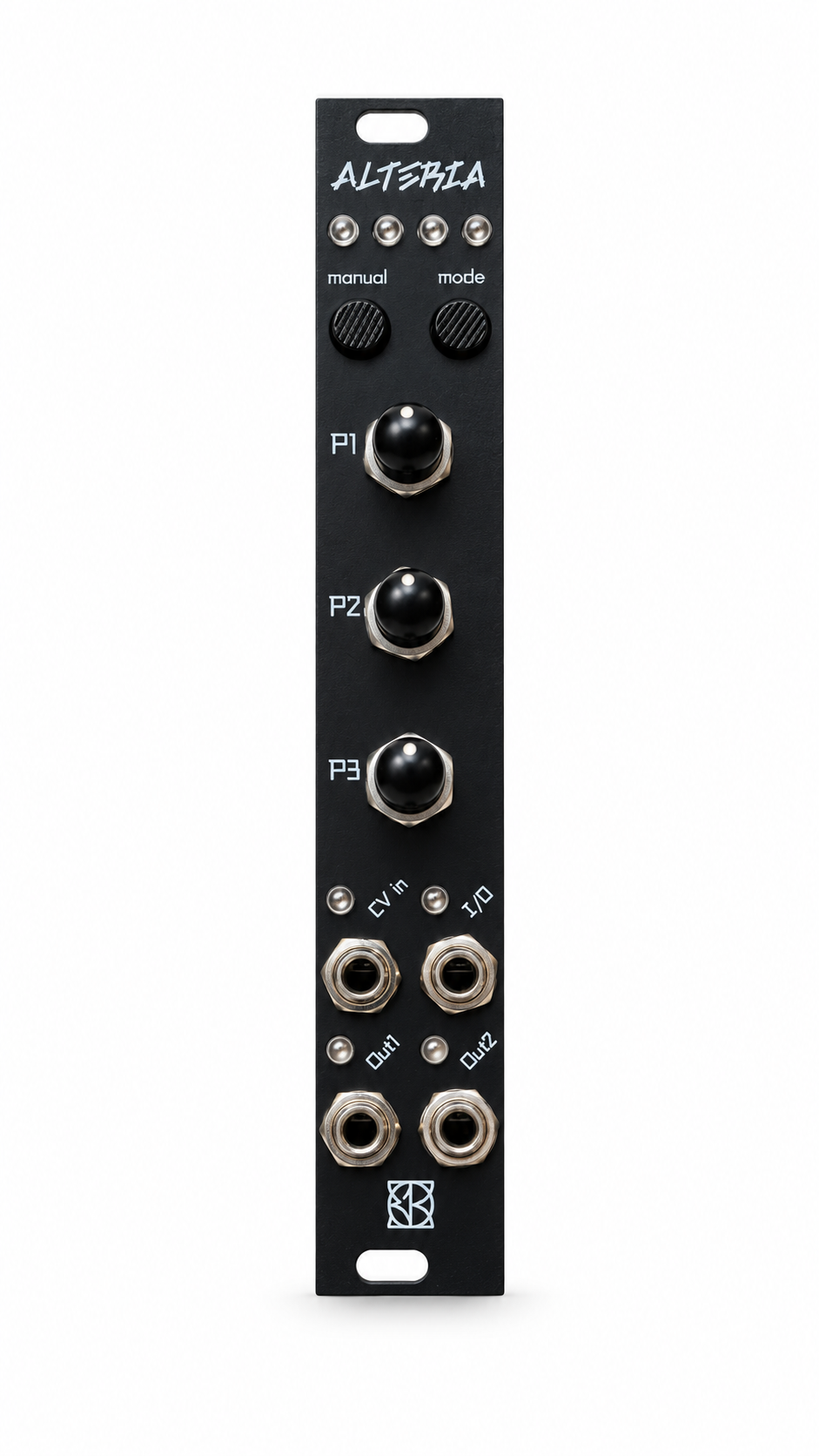
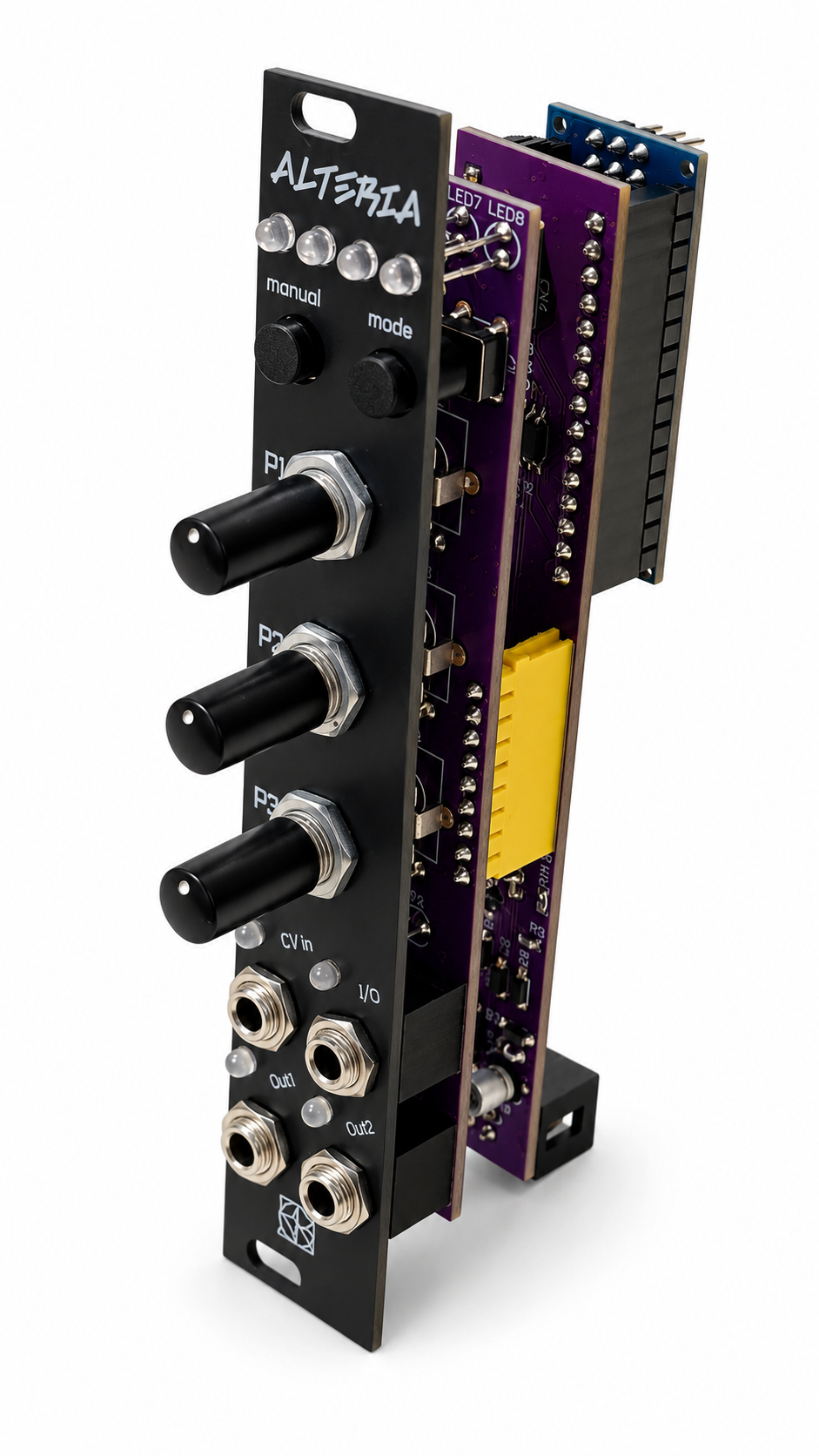
More product views
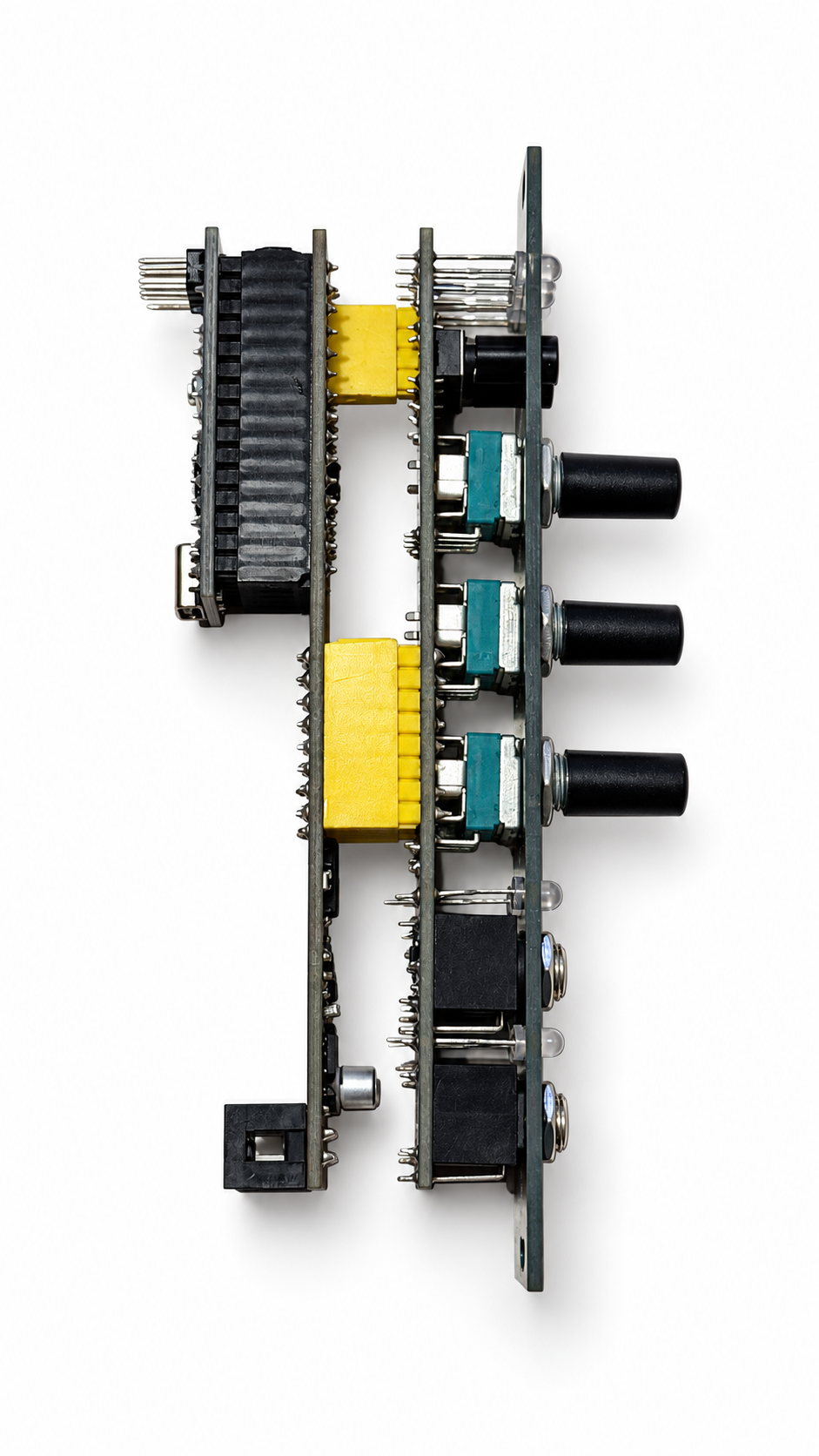
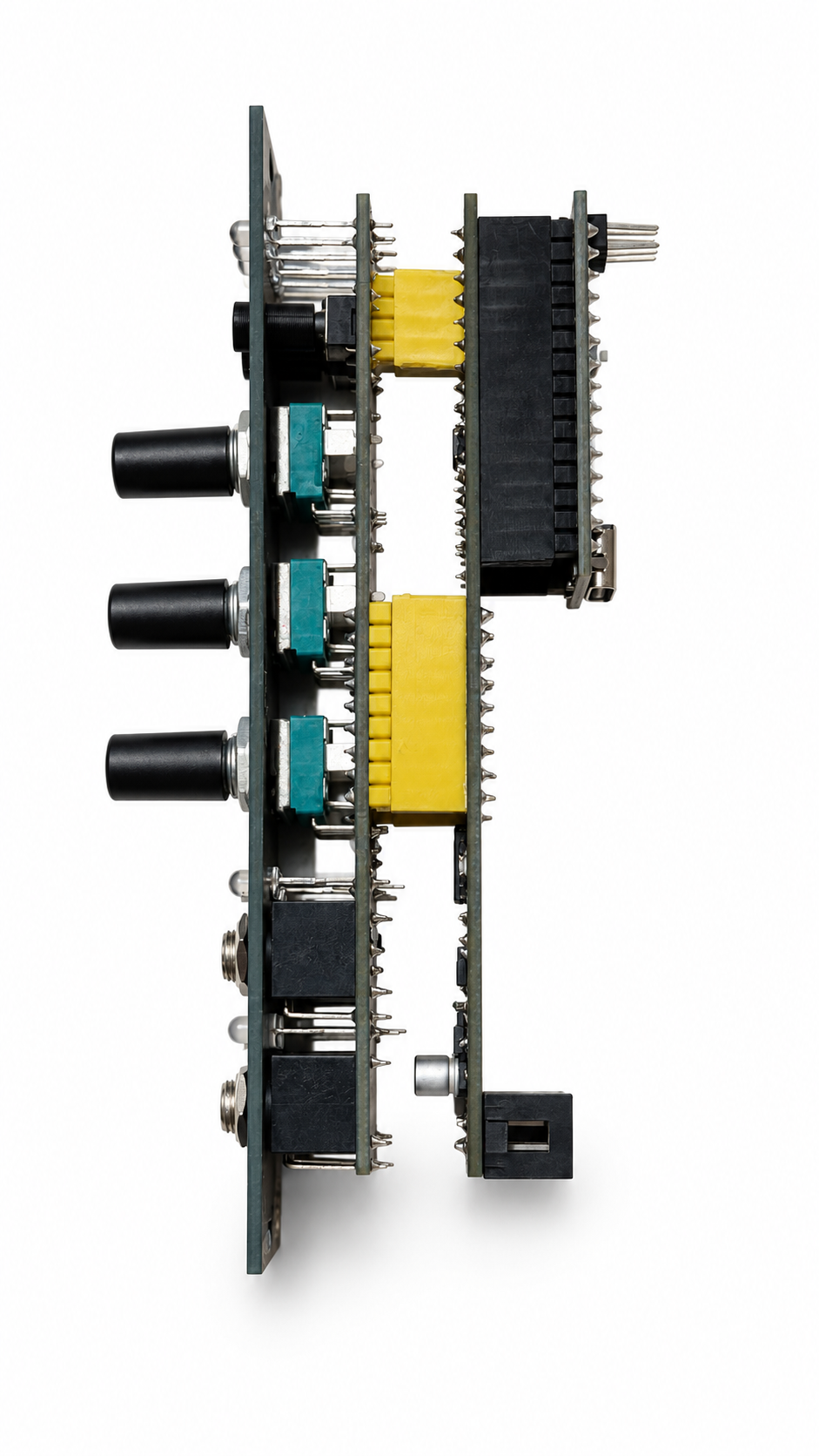
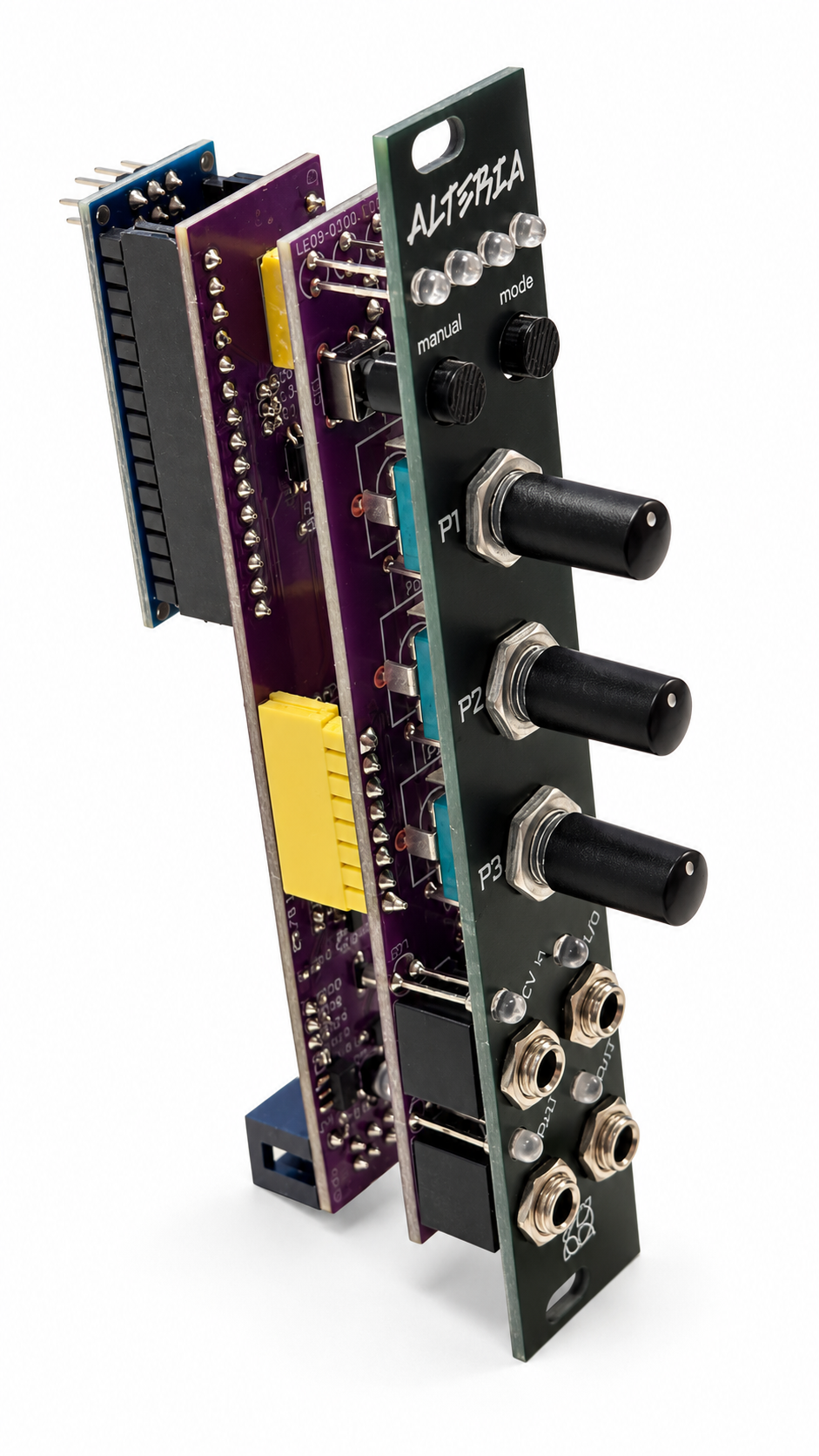
Allrounder manual · Calibration · DRUM LAB · Build and modify · Schematics
Quick reference: ALLROUNDER · DRUMLAB · FULLVOICE - experimental.
Choose your firmware
| Firmware | Version | Purpose | Hardware |
|---|---|---|---|
| ALLROUNDER | 2.0.2, 27 October 2026 | Sixteen modes covering envelopes, rhythm, modulation, pitch CV and two drum voices | REV5-2, Nano ATmega328P, 16 MHz |
| ALLROUNDER - experimental variant | 2.1.0, 31 October 2026, UNTESTED ON HARDWARE | Same 16-mode layout; mode 10 Acid Voice replaces Mutant Drums | Same hardware |
| DRUM LAB | 1.0.0, 27 October 2026 | Two independent percussion voices, each with eight selectable engines and three effects | Same hardware |
| FULL VOICE | 1.0.0, 31 October 2026, UNTESTED ON HARDWARE | Mono oscillator/filter/VCA voice, four editing pages, AD envelope, nominal V/oct + trigger input | Same hardware |
These are separate sketches; upload one at a time. They do not require an external audio library. SPI and EEPROM come with the Arduino AVR core. ATmega168P is not a supported replacement for these releases.
Download this repository with Code → Download ZIP, extract it, and open the matching .ino inside its own folder under firmware/. In Arduino IDE select Arduino Nano → ATmega328P; choose Old Bootloader only if required by your Nano. The development guide includes reproducible CLI builds and tests.
ALLROUNDER 2.0.2
One mode runs at a time. Short MODE presses advance 1–16. LEDs 1–4 have binary weights 1, 2, 4, 8; mode 16 uses preset indicators instead.
| # | Mode | In a patch |
|---|---|---|
| 1 | AD Shaper | Attack/decay envelope and event markers |
| 2 | AR Gate | Gate-held envelope with release |
| 3 | Dual Decay | Two independently triggered vactrol-style decays |
| 4 | Ducking | Smoothed response to control voltage |
| 5 | Burst | Trigger clusters with complementary ramps |
| 6 | Acid Generator | Clocked 16-step Phrygian pitch pattern, accents and slides |
| 7 | Tremolo / AutoPan | Complementary positive modulation CVs |
| 8 | Grids XY | Pattern-based kick/snare/hat triggers |
| 9 | Triple Clock | Three independent ratios from /8 to ×8, tap or external clock |
| 10 | Mutant Drums | Internal kick/snare audio synthesis |
| 11 | Logic XOR | Two clocks and XOR result |
| 12 | Turing Machine | Mutating register, CV and bit output |
| 13 | Humanizer | Event delays, swing and gate variation |
| 14 | Bernoulli 3 | Probabilistic event routing |
| 15 | Trance Gate | Twenty-four rhythmic patterns |
| 16 | Preset Manager | Four stored CV pairs and gates |
The full control table covers P1/P2/P3, CV IN, MANUAL, OUT1, OUT2 and I/O for every mode. Acid pitch needs an external oscillator/audio path; Tremolo/AutoPan supplies CV to external VCAs. Mutant Drums creates audio inside ALTERIA. Triple Clock needs at least three taps to set tempo and continues at its last tempo when an external clock stops.
Know the outputs
| Mode | OUT1 / OUT2 target | I/O jack |
|---|---|---|
| 1–9 and 11–15 | 0…+5 V CV/gate | Digital output, except mode 3: trigger input B |
| 10 | Approximately ±2.5 V audio | Snare trigger input |
| 16 | −5…+5 V CV | Stored digital gate output |
Disconnect external drivers from I/O before leaving mode 3 or 10 or restarting: other modes drive that jack as an output. These are firmware targets, not a certified electrical input range. Connect audio to an attenuated mixer/VCA input, not directly to headphones or speakers.
Calibration
Calibration is manual, with a multimeter at the output jacks. Hold MODE + MANUAL at power-on/reset, release at LED1, then adjust both outputs at 0 V, +5 V and −5 V using P1/P2. Center both knobs before each MANUAL confirmation. At blinking LED4, hold MANUAL 1 second to save. MODE held 1.2 seconds cancels. Read the complete calibration guide before starting.
The six points are stored per board in two CRC-protected EEPROM records. This adjusts output offset and positive/negative scale; it does not calibrate inputs or guarantee perfect 1 V/oct tracking.
ALLROUNDER 2.1.0 - Acid Voice
Experimental firmware; hardware validation pending. Published alongside 2.0.2, not over it. Only mode 10 changes to Acid Voice: P1 decay, P2 resonance, P3 Env Mod; CV IN pitch, I/O note trigger, MANUAL saw/square. OUT1 audio; OUT2 positive envelope, not snare audio. The other 15 modes, calibration and preset layouts are unchanged. Mode 6 remains an independent CV sequencer, not an internal sequencer for the new voice.
Sketch and manual · Version comparison / quick reference · Validation status. Software-tested, not physically validated. Recorded build: 30012 bytes flash, 1081 bytes static SRAM. I/O still changes direction outside modes 3/10: disconnect external drivers before exiting or restarting.
DRUM LAB 1.0.0
Two independent audio outputs. Assign Kick, Tom, Synth Perc, Snare, Clap, FM Metal, Closed Hat or Open Hat to either voice. SOUND controls pitch/duration/character; FX adds tone, drive and crush. Hat pairs support choke. This is original AVR synthesis inspired by broad percussion families, not an LXR firmware port or an official Erica Synths product.
- CV IN → voice A → OUT1; I/O → voice B → OUT2. I/O stays an input throughout DRUM LAB.
- MODE short: next engine on the selected voice. MODE held about 650 ms: select A/B.
- Hold MODE, add MANUAL within half a second, release both: switch SOUND/FX.
- MANUAL short: trigger the selected voice. MANUAL held 2 seconds: save the kit after the initial hit.
- Knobs use pickup after recall. Eight engines are available to each voice, with two voices sounding simultaneously, not eight.
Audio runs at 6.4 kHz with deliberate lo-fi character. There is no internal sequencer: use external triggers or MANUAL. Read the complete DRUM LAB manual, including EEPROM, LED meanings, calibration and attribution.
FULL VOICE 1.0.0 - experimental synthesizer
Experimental firmware; hardware validation pending. This experimental sketch has passed compilation, host tests and AVR binary simulation, but has not been validated on a physical module. It is not a stable/hardware-approved release.
CV IN is nominal 1 V/oct pitch; I/O stays an input for gate/trigger; OUT1 is filtered/VCA audio, OUT2 is a positive AD envelope. Four pages: OSC (waveform, PWM, fine tune), FILTER (cutoff, resonance, AD amount), VCA (level, AD amount, drive), ENV (Attack, Decay, curve; no sustain/release). MODE short goes forward, MANUAL short back; MANUAL held 500 ms auditions a note, MODE held 1.2 seconds saves the patch. Knobs use pickup.
Quick reference · Complete manual and sketch · Validation status. Lo-fi 6.4 kHz, approximately +/-2.5 V audio and 0..+5 V envelope targets. Physical levels, sound and V/oct tracking still require bench tests; output ACAL does not calibrate the pitch ADC. Recorded build: 14536 bytes flash, 513 bytes static SRAM. Allrounder and DRUM LAB sources remain unchanged.
Open source and development
Arduino sources, build instructions, regression suites and circuit schematics are included. Development guide · Validation results · Schematics.
ALLROUNDER 2.1.0 and FULL VOICE 1.0.0 are experimental, with hardware qualification pending. Version-specific test reports document compilation, simulation and resource use. Native CAD and a matching manufacturing package are not yet included.
Original materials: GNU GPL-3.0. License · Notice · Contribute.